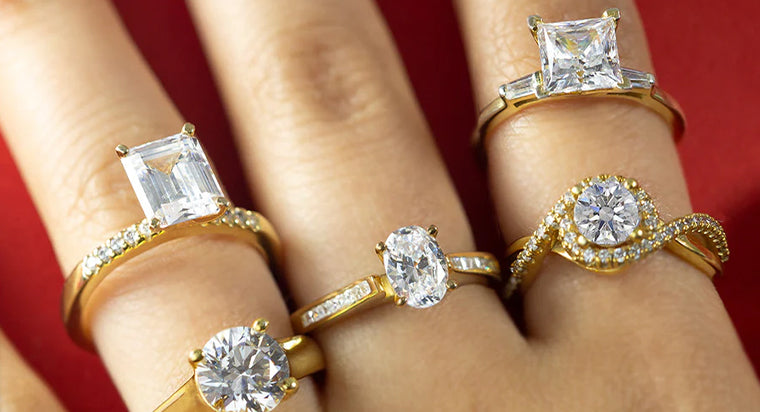

Yellow Gold Engagement Rings Diamond & Setting Choices
Yellow gold changes the way a diamond ring reads on the hand. Its warm tone creates visible contrast around a colourless stone, softens certain diamond shapes and gives even a restrained solitaire a distinct character. That makes yellow gold engagement rings especially interesting for buyers who want to balance diamond specifications with the appearance of the finished ring.
The metal choice also affects decisions that are easy to overlook during early shopping. Prong colour can change how the centre stone appears. Band width influences how substantial the ring feels. Diamond colour grades may look different beside warm gold than they do in a white-metal setting.
For buyers in Singapore, where an engagement ring may be worn daily through work, travel and social occasions, comfort and practical construction deserve as much attention as the initial appearance.
Yellow Gold Can Change How You Prioritise Diamond Colour
A diamond is graded for colour when viewed under controlled conditions, but an engagement ring is rarely viewed that way. Once the stone sits beside yellow gold, the surrounding metal becomes part of the visual impression.
This can influence how much value a buyer places on very high colour grades.
A near-colourless diamond may still appear attractively white in a yellow gold ring, particularly when the centre stone is held by white gold or platinum prongs. The white prongs visually separate the diamond from the warmer band and can reduce the amount of yellow reflected around its edge.
Using yellow gold prongs creates a different result. The ring looks more visually unified, but the metal may introduce additional warmth around the diamond.
Neither construction is automatically better. The useful question is whether you prefer a clearly defined centre stone or a warmer, more integrated appearance.
Diamond shape matters too
Colour is not equally noticeable in every diamond shape.
Round brilliant diamonds generally conceal body colour efficiently because of their faceting pattern. Step-cut diamonds, including emerald and Asscher shapes, present larger open facets, making colour and clarity characteristics easier to see.
Elongated shapes such as oval, pear and marquise diamonds may also show warmth near their pointed ends depending on the individual stone.
This is why selecting a diamond from a grading report alone can be limiting. Two diamonds carrying similar grades can produce noticeably different impressions once mounted in yellow gold.
The Setting Should Suit the Way the Ring Will Be Worn
A setting does far more than hold the diamond in position. It determines how high the stone sits, how exposed its edges are and how easily the ring works with a future wedding band.
A traditional four- or six-prong solitaire keeps attention on the centre stone and allows considerable light around it. Six prongs provide additional points of contact around a round diamond, while four prongs leave more of its outline visible.
A bezel setting surrounds most or all of the diamond’s perimeter with metal. It creates a cleaner profile and protects exposed edges well, though it changes the visual character substantially compared with an open-prong setting.
Pavé bands introduce smaller diamonds along the shank. They add surface sparkle but also bring additional maintenance considerations because numerous small stones and prongs are involved.
Hidden halos place small diamonds beneath the centre stone rather than around its visible face. They can add detail from the side without making the ring appear like a conventional halo from above.
For someone who regularly works with their hands, reaches into bags or pockets frequently, or prefers fewer raised details, a lower-profile construction may prove easier to live with.
Band Width Has More Influence Than It Seems
Very slim engagement-ring bands receive attention because they can make a centre diamond appear comparatively larger. There is still a structural trade-off.
A thinner shank contains less metal and may be more vulnerable to bending or distortion over long periods of wear. This matters particularly with larger centre stones, where the ring must support more weight above the finger.
A slightly wider band can create better visual balance with a substantial diamond while providing a stronger foundation.
The right width also depends on:
- finger size and proportions
- centre-stone dimensions
- setting height
- whether pavé diamonds are included
- the intended wedding-band width
- preference for a delicate or substantial appearance
Instead of judging the engagement ring alone, it is useful to picture the eventual two-ring combination. Two individually attractive rings can feel crowded once worn together if their proportions were chosen separately.
Carat Weight Does Not Tell You How Large a Diamond Will Look
Carat measures weight rather than visible diameter.
Two one-carat diamonds can face up differently depending on their proportions. A diamond carrying excess weight beneath its girdle may have a smaller visible surface than another stone of the same weight.
This becomes particularly relevant with fancy shapes. Oval, emerald, radiant and pear-shaped diamonds can vary substantially in length and width while sharing identical carat weights.
Rather than starting and ending with carat weight, compare the actual millimetre dimensions listed on a grading report.
Length-to-width ratio is useful as well. It describes whether an elongated diamond appears relatively broad or slender, but there is no single ratio that suits every buyer. The better proportion is the one that looks balanced with the setting and finger.
Buyers comparing natural and lab diamonds should apply the same basic assessment: look beyond carat weight and examine cut quality, dimensions, colour, clarity and the grading documentation together.
Where Lab-Grown Diamonds Fit Into the Design Decision
Lab-grown diamonds have essentially the same carbon crystal structure and fundamental optical properties as mined diamonds; their difference is origin.
For engagement-ring design, that means the same principles of cut, colour, clarity, shape and proportions remain relevant.
A lab-grown stone should not be selected simply because a larger carat weight becomes accessible within a particular budget. Increasing size can alter the entire ring.
A larger centre stone may require:
- a stronger basket or setting
- different prong proportions
- a wider shank
- a higher or redesigned gallery
- additional consideration of wedding-band clearance
The ring should therefore be designed around the stone rather than treating the diamond and mounting as independent purchases.
An independent grading report from a recognised gemological laboratory also allows buyers to verify the stated characteristics of an individual diamond rather than relying solely on a retailer’s description.
Mixed Metals Can Solve a Practical Design Problem
A yellow gold band does not require every visible component to be yellow gold.
Using yellow gold for the shank with white gold or platinum around the diamond can create useful visual separation. The band retains its warm character while the centre setting appears more neutral beside the stone.
Some buyers prefer matching yellow gold throughout because it creates a consistent appearance from every angle. Others favour the mixed-metal approach precisely because the setting becomes less noticeable around the diamond.
This choice is particularly worth discussing before ordering a custom ring, since prong colour can be difficult to appreciate from a simple top-down product image.
Ask to see the ring from the front, side and three-quarter angle whenever possible.
Plan the Engagement Ring and Wedding Band Together
One of the easiest mistakes to avoid is treating the wedding band as a decision for another day.
Some engagement-ring galleries sit low enough that a straight wedding band cannot rest directly beside the engagement ring. The result is either a visible gap or the need for a curved, contoured or custom-fitted band.
Neither outcome is inherently undesirable, but it should be intentional.
Before confirming a ring, ask:
- Will a straight wedding band sit flush beside it?
- Does the centre basket extend below the shank?
- Will pavé surfaces rub against the neighbouring ring?
- Can the ring be resized later?
- How should the prongs and setting be inspected over time?
- Can the wedding band be made in the same gold alloy and finish?
These questions become particularly useful for Singapore buyers ordering remotely, where ring sizing, production details and future servicing should be clarified before the piece is made.
A well-proportioned yellow gold engagement ring is the result of several connected choices rather than one impressive specification. Diamond dimensions, setting height, prong metal, band width and wedding-band compatibility all affect how the piece looks and behaves after years of regular wear. Considering those details together produces a ring that makes sense from every angle, not only in the first photograph.